
このページはまだ日本語に翻訳されていないため、英語で表示しています。
Models
AI models available in Foxl
Foxl Agent supports your own API keys and cloud accounts (BYOK, Amazon Bedrock included), local models, and supported Claude / ChatGPT subscriptions (BYOA). Configure them under Settings > Model & provider. Model usage on this local path stays on your provider's billing.
code.foxl.ai is a separate managed SaaS. Its orchestrator and managed coding agents use Foxl Relay credits. Remote Kiro and Cursor use a vendor API key saved in Code settings and charge Foxl credits for compute only. Remote Code tasks opened from the desktop app use these same access paths. See Code model access.
BYOK Models
Bring your own key: every model in this section runs on credentials you supply, and its usage is billed by that provider to your account (or costs nothing, for a local model), not by Foxl. Amazon Bedrock is BYOK too - Foxl calls it with your own AWS account. See AI Providers for setup.
Amazon Bedrock (your own AWS account)
These run on your own AWS account: connect it under Settings > Model & provider > Amazon Bedrock, and AWS bills the usage to that account. Which models you can call, and their context limits, depend on what your account has enabled in its Region. The Code managed catalog is listed separately on the page linked above.
| Model | Made by | Context | Best For |
|---|---|---|---|
| Claude Opus 5.5 | Anthropic | 1M tokens | Foxl Agent and Foxl Code default; built for long-running agentic coding and knowledge work, and cheaper than Opus 5 ($4 / $20 per MTok) |
| Claude Opus 5 | Anthropic | 1M tokens | Previous default; matches or beats Fable 5 on agentic coding and professional knowledge work at half the price |
| Claude Fable 5.1 | Anthropic | 1M tokens | Claude model for complex coding and reasoning |
| Kimi K3 | Moonshot | 1M tokens | Open-weight model with native vision; long coding and knowledge work across large repositories, documents and images |
| GLM 5.3 | Z.AI | 1M tokens | Open-weight model for agentic coding and long multi-step engineering work; text only, reasoning effort from none to max |
| GLM 5 | Z.AI | 200K tokens | Legacy: superseded by GLM 5.3; listed only with Show older model versions on |
| Kimi K2.5 | Moonshot | 256K tokens | Reasoning and tool use |
| Claude Fable 5 | Anthropic | 1M tokens | State-of-the-art on most benchmarks; ambitious long-running work, advanced vision |
| Claude Opus 4.8 | Anthropic | 1M tokens | Previous coding/desktop default; longer autonomous runs, lower output variance for enterprise workflows |
| Claude Opus 4.7 | Anthropic | 1M tokens | Legacy: same API surface as 4.8; listed only with Show older model versions on |
| Claude Opus 4.6 | Anthropic | 1M tokens | Legacy: older Opus, still 1M context; listed only with Show older model versions on |
| Claude Sonnet 5.5 | Anthropic | 1M tokens | Latest Sonnet: faster than Sonnet 5 at $2 / $10 per MTok; everyday coding, bug fixes and documents |
| Claude Sonnet 5 | Anthropic | 1M tokens | Notes default; balanced speed and quality |
| Claude Sonnet 4.6 | Anthropic | 1M tokens | Legacy: superseded by Sonnet 5 and 5.5; listed only with Show older model versions on |
| Claude Haiku 5.5 | Anthropic | 1M tokens | Fastest model, for high-volume work (titles, suggestions, translation, classification) at $0.10 / $0.50 per MTok up to 100K prompt tokens |
| Claude Haiku 4.5 | Anthropic | 200K tokens | Legacy: superseded by Haiku 5.5; listed only with Show older model versions on |
| GPT-6 Astra | OpenAI | 1.05M tokens | OpenAI's most capable model, built for the hardest end-to-end work - complex reasoning, coding, computer use, research and document creation |
| GPT-6.1 Sol | OpenAI | 1.05M tokens | Near-Astra agentic coding, computer use and professional work at $2 / $10 per MTok (cached input $0.10). Reasoning is always on |
| GPT-6.1 Terra | OpenAI | 1.05M tokens | Fast, efficient middle tier for visual reasoning, computer use and writing at $1 / $5 per MTok (cached input $0.05). Reasoning can be turned off |
| GPT-6 Sol | OpenAI | 1.05M tokens | Legacy: superseded by GPT-6.1 Sol; listed only with Show older model versions on. Same price; unlike 6.1, reasoning can be turned off |
| GPT-6 Luna | OpenAI | 1.05M tokens | The cheapest GPT-6 tier ($0.10 / $0.50 per MTok); fast, high-volume work |
| GPT-5.6 Sol | OpenAI | 1M tokens | Legacy: superseded by the GPT-6 generation; listed only with Show older model versions on |
| GPT-5.6 Terra | OpenAI | 1M tokens | Legacy: superseded by GPT-6.1 Terra; listed only with Show older model versions on |
| GPT-5.6 Luna | OpenAI | 1M tokens | Legacy: superseded by the GPT-6 generation; listed only with Show older model versions on |
| GPT-5.5 | OpenAI | 272K tokens | Previous OpenAI frontier reasoning; can search the web with Amazon Bedrock Web Search |
| GPT-5.4 | OpenAI | 272K tokens | Legacy: general-purpose OpenAI reasoning; listed only with Show older model versions on |
| Grok 4.7 | xAI | 500K tokens | xAI's frontier model for coding, agentic tasks and knowledge work; built for long-running agents |
| Grok 4.6 | xAI | 500K tokens | Legacy: superseded by Grok 4.7; listed only with Show older model versions on |
| Gemma 4 31B | 256K tokens | Cheap and fast for short mechanical transforms (dictation cleanup, summaries). No tool use, no vision |
Superseded models are hidden until you ask for them. Opus 4.7, Opus 4.6, Sonnet 4.6, Haiku 4.5, GLM 5, GPT-6 Sol, GPT-5.6 Sol / Terra / Luna, GPT-5.4 and Grok 4.6 stay fully runnable - same pricing, same tier eligibility, a saved selection keeps working - but they drop out of every picker unless Show older model versions is on in Settings > Model & provider. The one exception is GPT-5.6 in Foxl Code's managed catalog (Foxl credits): GPT-6 Sol, GPT-6 Luna and GPT-6.1 Sol are not on credits, so GPT-5.6 Sol / Terra / Luna stay in the main list there.
GPT-6.1 Sol (gpt-6.1-sol, released September 29, 2026) is the upgrade to GPT-6 Sol and replaces it in the picker. It comes close to GPT-6 Astra on agentic coding, computer use and professional work, at GPT-6 Sol's price: $2 / $10 per MTok, with cached input down to $0.10 (from $0.20). 1.05M context, 128K output.
- Reasoning is always on. Like GPT-6 Astra, it accepts
lowthroughmax(defaultmedium) and refusesnone, so Foxl offers no off switch for it. GPT-6 Sol, which can turn reasoning off, stays available with Show older model versions on. - Reach it with your own AWS account (Settings > Model & provider > Amazon Bedrock) or an OpenAI API key. It is not in Foxl Code's managed catalog.
- It is also on a ChatGPT Plus/Pro sign-in, confirmed working on that connection - see Subscription (OAuth) Models below. There its window is 500K rather than 1.05M, and GPT-6 Sol moves behind Show older model versions as it does on Amazon Bedrock.
GPT-6.1 Terra (gpt-6.1-terra, released October 26, 2026) is the GPT-6 generation's fast, efficient middle tier and the successor to GPT-5.6 Terra: visual reasoning, precise computer use and clear writing at $1 / $5 per MTok, with cached input at $0.05. 1.05M context, 128K output.
- Reasoning can be turned off. It accepts
nonethroughmax(defaultmedium), like GPT-6 Sol and Luna and unlike GPT-6.1 Sol. - Reach it with your own AWS account (Settings > Model & provider > Amazon Bedrock). It is not in Foxl Code's managed catalog.
- It is also on a ChatGPT Plus/Pro sign-in, confirmed working on that connection - see Subscription (OAuth) Models below. There its window is 500K rather than 1.05M, and reasoning can be turned off there too.
GPT-6 Sol and GPT-6 Luna (gpt-6-sol, gpt-6-luna, GA September 22, 2026) are the cheaper tiers of the Astra generation, at half their GPT-5.6 counterparts' prices: Sol $2 / $10 per MTok and Luna $0.10 / $0.50, with cached input at a tenth of input. 1.05M context, 128K output. Reasoning is adjustable and CAN be switched off - unlike Astra, both accept a none effort level - and the default is medium.
Reach them with your own AWS account (Settings > Model & provider > Amazon Bedrock) or an OpenAI API key. Two limits worth knowing, both measured rather than assumed:
- They are not in Foxl Code's managed catalog. Foxl's managed OpenAI path does not offer these two models yet, so they need your own account.
- They are also on a ChatGPT Plus/Pro sign-in, confirmed working on that connection - see Subscription (OAuth) Models below. There the window is 272K rather than 1.05M, which is the transport's limit for every GPT slug and not something specific to these two.
GPT-6 Astra is reachable in Foxl Agent with your own AWS account, a ChatGPT subscription, or an OpenAI API key. Managed Code access uses its own catalog and credit balance. See Other API keys and local models and Subscription (OAuth) Models below.
Claude Opus 5.5 (claude-opus-5-5, GA 2026-09-22) is the new default across Foxl Agent and Foxl Code's coding agent, and it backs the expert complexity tier in desktop routing. 1M context, 128K max output, vision, knowledge cutoff June 2026. It lists at $4 / MTok input and $20 / MTok output - LESS than the Opus 5 it replaces ($5 / $25). Cache reads are $0.20 / MTok (5% of input, like Sonnet 5.5 since October 7, 2026; most other Claude models charge 10%) and 5-minute cache writes are $5 / MTok.
Thinking cannot be turned off on this model. Adaptive thinking is always on, so the model selector shows the effort levels with no on/off switch, and effort is the only depth control. Its default effort is medium, not the high every other Opus tier uses - and at the same level it thinks more per turn than Opus 5, so re-check a setting you carry over rather than assuming the cost is unchanged.
Forced tool use is also gone: a request that pins tool_choice to a specific tool, or to "any tool", is refused. Nothing in Foxl sends one.
Foxl Notes keeps Sonnet 5 as its default. Opus 5 remains selectable. In Foxl Agent, reach Opus 5.5 with your own Anthropic or Bedrock credentials, or a Claude Pro/Max sign-in through Claude Code. Managed Code uses Foxl credits, charged at what Amazon Bedrock bills for the US cross-Region profile it runs on: $4.40 / $22 per MTok, 10% above list, like every Claude model on Foxl credits except Sonnet 5.5 and Sonnet 5 (Model rates used by Relay).
On Bedrock, Opus 5.5 is us.anthropic.claude-opus-5-5. Both the us. and global. cross-region inference profiles were verified live from us-west-2 and us-east-1, so there is no region pin, and no data-retention opt-in is required. Computer use is unaffected here: Bedrock still accepts the earlier computer_20251124 tool for this model, unlike the Claude API and Google Cloud.
Claude Opus 5 (claude-opus-5, GA 2026-07-24) is the previous default for Foxl Agent and Foxl Code's coding agent. It remains selectable alongside Opus 5.5. It has 1M context, 128K max output, vision, and a May 2026 knowledge cutoff. It lists at $5 / MTok input and $25 / MTok output. Cache reads are $0.50 / MTok and 5-minute cache writes are $6.25 / MTok. Reach it with your own Anthropic or Bedrock credentials, or a Claude Pro/Max subscription.
Claude Sonnet 5.5 (claude-sonnet-5-5, GA 2026-09-28) is the latest Sonnet. It is selectable with your own Anthropic key or Bedrock credentials, with a Claude Pro/Max sign-in, in Foxl Notes, and in Foxl Code on Foxl credits. Sonnet 5 stays the Foxl Notes default. 1M context, 128K max output, vision, knowledge cutoff June 2026. It lists at $2 / MTok input and $10 / MTok output, with 5-minute cache writes at $2.50 / MTok. Cache reads are $0.10 / MTok since October 7, 2026, half the earlier $0.20 - on the Claude API, on Amazon Bedrock (AWS lowered its price the same day) and so on Foxl credits, which bill what Bedrock charges.
Thinking cannot be turned off on this model, the same as Opus 5.5: the model selector shows its five effort levels with no on/off switch. Foxl defaults it to medium effort. Effort levels are recalibrated on this model, so a level does not produce the same amount of thinking as it did on Sonnet 5. Forced tool use is refused, as on Opus 5.5; nothing in Foxl sends it.
On Bedrock, Sonnet 5.5 is global.anthropic.claude-sonnet-5-5. That global cross-region profile is its only one: a us. profile does not exist for this model. It was verified live from us-west-2 and us-east-1. A global profile can route a request to any AWS commercial Region (AWS: cross-Region inference), so unlike the other Claude models on Foxl credits, a Sonnet 5.5 request is not kept inside the US. Claude Code (Pro/Max sign-in) mode lists it too, capped at 200K tokens there like Sonnet 5.
Claude Haiku 5.5 (claude-haiku-5-5, GA 2026-10-07) is the latest Haiku and replaces Haiku 4.5, which moves to the older models. It is Foxl's small fast model: the greeting suggestions, session summaries on Amazon Bedrock and Foxl Code's chat orchestrator run on it, it names chats on Amazon Bedrock with your own AWS account and on a Claude Pro/Max sign-in (and on OpenRouter when the free naming model cannot; see How chats are named), and so do Foxl Notes' title and live translation models when set to Automatic with an Anthropic key (on Amazon Bedrock, Automatic runs Gemma 4 31B first and Haiku 5.5 only if the account refuses Gemma 4 and GPT-6 Luna; a Claude Pro/Max sign-in lists no Haiku, so there Automatic runs Foxl Agent's own model). 1M context (Haiku 4.5 had 200K), 128K max output, vision, knowledge cutoff June 2026.
It is priced by prompt length. Up to 100,000 prompt tokens it lists at $0.10 / MTok input and $0.50 / MTok output, with cache reads at $0.01 and 5-minute cache writes at $0.125, a tenth of Haiku 4.5's prices. Above 100,000 tokens the whole request is billed at five times those rates. It also uses the newer tokenizer, so the same text counts as about 30% more tokens than on Haiku 4.5.
Thinking is adaptive and can be turned off. Unlike Haiku 4.5, it thinks when a request does not mention thinking, so Foxl sends thinking off explicitly whenever thinking is switched off and for every helper call - a title or a translation segment runs without reasoning, as it did on Haiku 4.5. With thinking on, it takes effort levels low through max; its default is medium. temperature, top_p and top_k are refused, and so is an assistant prefill; nothing in Foxl sends either.
On Bedrock it is us.anthropic.claude-haiku-5-5 on Foxl credits (the US cross-Region profile, $0.11 / $0.55 per MTok, 10% above list like the other Claude models) and global.anthropic.claude-haiku-5-5 on your own AWS account. Both profiles were verified live from us-west-2.
What moved to it. A Notes helper model left on its default moves to Haiku 5.5 by itself, and so does a Notes helper set to Haiku 4.5 - the two cannot be told apart, because Haiku 4.5 was the stored default. Every other saved selection (a chat model, a schedule, an agent definition) keeps running the model it names, Haiku 4.5 included. Context compaction is unchanged: it summarizes with the model the conversation runs on, which reads that model's prompt cache.
On Bedrock, Opus 5 is us.anthropic.claude-opus-5 (both the us. and global. cross-region inference profiles work, no region pin) and runs with zero data retention by default - no data-retention opt-in is required, unlike Fable 5. Higher-risk prompts may be answered by Opus 4.8 instead and are billed at Opus rates.
Managed Code serves the GPT-5.6 family (Sol, Terra, Luna) plus GPT-5.5 / GPT-5.4 through Amazon Bedrock's native OpenAI Responses API. In Foxl Agent, use your own AWS account or an OpenAI API key. The supported ChatGPT subscription models are listed below; that path excludes GPT-5.4 and GPT-5.4 Mini. All three GPT-5.6 tiers support reasoning effort up to max.
As of August 3, 2026, GPT-5.6 Sol, Terra and Luna serve the full 1M-token window on Amazon Bedrock, so a whole repository, a long contract or a full multi-step agent history fits in one request. Prompt caching with explicit cache breakpoints applies to those long-context requests, and repeated context is billed at a 90% discount.
GPT-5.5 and GPT-5.4 are still capped at 272K tokens (278,528) on Bedrock - AWS's announcement covers the 5.6 generation only.
The ChatGPT (Codex) OAuth transport serves 272K for the GPT family, the 5.6 trio and GPT-6 Astra included - that 1M is Bedrock's, and it does not carry over to a subscription. The exceptions are GPT-6.1 Sol and GPT-6.1 Terra at 500K. The figures are the Codex endpoint's own: every other slug it serves reports context_window: 272000 there, and the two GPT-6.1 models report 500000. Foxl uses the limit of the active provider for its context meter and model configuration, so the same model reports a different window depending on how you are connected.
GPT-5.6 introduces billed prompt-cache writes (1.25x the input rate) alongside discounted cache reads (90% off). Foxl meters both accurately - cached GPT traffic is billed at the discounted read rate, not the full input price.
Grok 4.7 (grok-4.7, GA on Amazon Bedrock 2026-09-28) is xAI's frontier model for coding, agentic tasks and knowledge work, with a 500K-token context window, image and document input, and reasoning effort low, medium, high or xhigh. Its reasoning cannot be turned off, so the model selector shows the effort levels with no on/off switch; Foxl starts it at high, the platform default. It lists at $2.20 / MTok input and $6.60 / MTok output, with cache reads at $0.55 / MTok, on Foxl credits and on your own AWS account.
Grok 4.6 (grok-4.6) is the previous Grok and is now an older model version: hidden by default, still selectable with Show older model versions on. Its reasoning can no longer be turned off either (Bedrock now refuses effort none for it), so a thinking-off request runs at low. Same price as Grok 4.7.
It is served from us-west-2, the one region Bedrock offers it in on that endpoint, independently of where the GPT models are served.
GLM 5.3 (Z.AI) and Kimi K2.5 (Moonshot) are available in Foxl Agent with your own AWS account (Amazon Bedrock under Settings > Model & provider) and separately on Code SaaS through Foxl Relay credits. Both vendors also serve their newer models directly - add a Z.ai or Kimi key in the same pane.
Kimi K3 is your-own-AWS-account only - it is not on Foxl Relay credits, so it appears under Amazon Bedrock and nowhere else. Foxl calls it through Bedrock's OpenAI-compatible Responses API rather than Converse, which is what AWS recommends for this model and what lets it read an attached PDF and reuse a cached prompt; on Converse the same model refuses both. GLM 5 is superseded by GLM 5.3 and sits in the older-models group, hidden until you turn on the show-legacy-models switch in Settings; it still runs exactly as before, including for saved selections and scheduled tasks. GLM 5.3 runs only through Bedrock's US cross-Region inference profile, which Foxl uses automatically. AWS serves that profile from us-east-1 and us-west-2 (Foxl's default) today, so with your account set to another Region this model answers with an error. Amazon also gives GLM 5.3 only to AWS accounts it has approved.
Claude Fable 5 ships with built-in safeguards. Prompts in sensitive domains (cybersecurity, biology, chemistry, health) are automatically answered by Opus 4.8 instead and billed at Opus rates.
Other API keys and local models
| Model | Provider | Context | API Key From |
|---|---|---|---|
| Claude Opus 5.5 | Anthropic | 1M tokens | console.anthropic.com |
| Claude Opus 5 | Anthropic | 1M tokens | console.anthropic.com |
| Claude Fable 5 | Anthropic | 1M tokens | console.anthropic.com |
| Claude Fable 5.1 | Amazon Bedrock only | 1M tokens | your own AWS account - Foxl lists it under Amazon Bedrock only |
| Claude Opus 4.8 | Anthropic | 1M tokens | console.anthropic.com |
| Claude Sonnet 5.5 | Anthropic | 1M tokens | console.anthropic.com |
| Claude Sonnet 5 | Anthropic | 1M tokens | console.anthropic.com |
| Claude Haiku 5.5 | Anthropic | 1M tokens | console.anthropic.com |
| Claude Opus 4.7, Opus 4.6, Sonnet 4.6 | Anthropic | 1M tokens | older generation - shown once Show older model versions is on |
| Claude Haiku 4.5 | Anthropic | 200K tokens | older generation - shown once Show older model versions is on |
| GPT-6 Astra | OpenAI or Amazon Bedrock | 1.05M tokens | platform.openai.com, or your own AWS account as us.openai.gpt-6-astra |
| GPT-6.1 Sol | OpenAI or Amazon Bedrock | 1.05M tokens | platform.openai.com, or your own AWS account as us.openai.gpt-6.1-sol |
| GPT-6.1 Terra | Amazon Bedrock | 1.05M tokens | your own AWS account as us.openai.gpt-6.1-terra |
| GPT-6 Sol | OpenAI or Amazon Bedrock | 1.05M tokens | older generation - shown once Show older model versions is on |
| GPT-6 Luna | OpenAI or Amazon Bedrock | 1.05M tokens | platform.openai.com, or your own AWS account as us.openai.gpt-6-luna |
| GPT-5.6 Sol / Terra / Luna | OpenAI | 1M tokens | older generation - shown once Show older model versions is on |
| GPT-5.5 | OpenAI | 1M tokens | platform.openai.com |
| GPT-5.4, GPT-4.1, GPT-4.1 Mini, o3, o4-mini, GPT-4o | OpenAI | 1M / 200K / 128K | older generation - shown once Show older model versions is on in Settings > Model & provider |
| Gemini 3.8 Flash | 1M tokens | aistudio.google.com | |
| Gemini 3.5 Flash-Lite | 1M tokens | aistudio.google.com | |
| Gemini 4 Argon | 1M tokens | aistudio.google.com, on a paid API key only - a free-tier key is refused with a quota error | |
| Gemini 2.5 Pro, Gemini 2.5 Flash | 1M tokens | older generation - shown once Show older model versions is on | |
| The whole Bedrock catalog | Amazon Bedrock | Varies | your own AWS account - every model in Amazon Bedrock above |
| Gemma 4 E4B, E2B, 12B | On this device (Mac with Apple Silicon, a Windows PC or a Linux x64 computer) | 32K tokens (64K with 32 GB of memory) | Free - one download under Settings > Model & provider > On this device, see AI Providers |
| Llama 3, Mistral, etc. | Ollama | Varies | Free - ollama.com |
| Whatever the vendor's catalogue reports | OpenRouter, DeepSeek, Groq, Together, Mistral, Fireworks, Z.ai, Kimi, Qwen, MiniMax, Perplexity, xAI, Cerebras, SambaNova, Cohere, AI21, Hugging Face | Varies | that vendor's own key - Foxl asks each configured vendor for its live model list |
| Any model your server loads | vLLM, LM Studio | Varies | Free - a local OpenAI-compatible endpoint |
Subscription (OAuth) Models
Use your existing subscriptions. Desktop only - see Providers for setup. For Claude Pro/Max and ChatGPT Plus/Pro, Foxl calls the vendor API directly with your OAuth token, and Settings > Model & provider shows how much of the plan's 5-hour and weekly limits you have used (Plan usage). The Gemini CLI is different: Foxl runs the gemini CLI itself, so its models answer without Foxl's tools and cannot run schedules or other background work.
Claude Code (Anthropic Pro/Max)
| Model | Context | Best For |
|---|---|---|
| Opus 5.5 (Claude Code mode) | 1M tokens | Current flagship (claude-code/claude-opus-5-5); long-running agentic coding. Verified served by the subscription pool, with 1M context native. The legacy claude-code/opus alias now maps here |
| Opus 5 (Claude Code mode) | 1M tokens | Previous flagship (claude-code/claude-opus-5); coding, agentic workflows, long-horizon autonomy |
| Fable 5 (Claude Code mode) | 1M tokens | State-of-the-art; most capable for ambitious, long-running work |
| Opus 4.8 (Claude Code mode) | 1M tokens | Previous flagship; coding, agentic workflows, long-horizon autonomy |
| Opus 4.7 (Claude Code mode) | 1M tokens | Stable Opus tier; same API surface as 4.8. Behind Show older model versions |
| Sonnet 5.5 (Claude Code mode) | 200K tokens | Latest Sonnet (claude-code/claude-sonnet-5-5); thinking always on, effort levels only (200K cap on subscription pool) |
| Sonnet 5 (Claude Code mode) | 200K tokens | Near-Opus intelligence; balanced speed and quality (200K cap on subscription pool) |
| Fable 5.1 (Claude Code mode) | 1M tokens | Most capable Mythos-class model. Needs Extra-usage credits on your Anthropic account - see below |
| Sonnet 4.6 (Claude Code mode) | 200K tokens | Previous Sonnet (200K cap on subscription pool). Behind Show older model versions |
Fable 5.1 is offered here but is not part of the Pro/Max subscription pool. Measured
against the live transport: with the CLI version cleared, a Pro token answers
HTTP 429 "Usage credits are required for this model." on every request. Anthropic serves
Fable 5.1 to accounts that carry Extra usage credits and bills it against those, so the
row is listed for accounts that have them. An account without credits gets that message
straight away rather than after a retry backoff. Fable 5.1 is also available through Amazon
Bedrock with your own AWS account, where it is billed at the usual per-token rate.
Claude Code (OAuth) runs in compatibility mode so requests route through your Claude Pro/Max subscription instead of pay-as-you-go "Extra usage". In this mode the agent gets only Bash, Read, Grep and WebFetch; every other tool, including writing files, memory, subagents, schedules, the browser and your MCP and custom tools, is left out, and Settings > Model & provider lists them by name. Neither Haiku 4.5 nor Haiku 5.5 is exposed in this mode. For the full Foxl tool surface, use an Anthropic API key (BYOK) or Claude on Amazon Bedrock through your own AWS account.
OpenAI (ChatGPT Plus/Pro)
Every row below is 272,000 tokens on this transport except GPT-6.1 Sol and GPT-6.1 Terra, which are 500,000 - the Codex endpoint's exact figures, not the 1M Bedrock offers. See the context-window callout above.
| Model | Context | Best For |
|---|---|---|
| GPT-6 Astra | 272K tokens | OpenAI's most capable model; complex, demanding work. Reasoning is always on (low - max, default low) |
| GPT-6.1 Sol | 500K tokens | The upgrade to GPT-6 Sol; close to Astra on agentic coding and professional work. Reasoning is always on (low - max, default medium) |
| GPT-6.1 Terra | 500K tokens | Fast, efficient middle tier for visual reasoning, computer use and writing. Reasoning can be turned off |
| GPT-6 Luna | 272K tokens | Fastest GPT-6 tier; high-volume work. Reasoning can be turned off |
| GPT-6 Sol | 272K tokens | Previous Sol; reasoning can be turned off. Behind Show older model versions |
| GPT-5.6 Sol | 272K tokens | Previous flagship reasoning. Behind Show older model versions |
| GPT-5.6 Terra | 272K tokens | Previous balanced tier. Behind Show older model versions |
| GPT-5.6 Luna | 272K tokens | Previous fast tier. Behind Show older model versions |
GPT-5.5, GPT-5.4 and GPT-5.4 Mini are not on this transport. OpenAI does not serve them
to ChatGPT accounts - measured on the live endpoint, every request answers
HTTP 400 "The 'gpt-5.4' model is not supported when using Codex with a ChatGPT account."
(and the same for gpt-5.4-mini and, since October 2026, gpt-5.5) - so none of them is in
this list. GPT-5.5 and GPT-5.4 are still reachable through Amazon Bedrock with your own AWS
account or an OpenAI API key (GPT-5.4 behind Show older model versions). Foxl does not
offer GPT-5.4 Mini on any provider.
GPT-6 Astra (gpt-6-astra, launched September 4, 2026; GA on Amazon Bedrock
September 8, 2026) is OpenAI's most capable model.
1,050,000-token context, 128,000 max output, text and image input, knowledge cutoff
April 30, 2026. It lists at $10 / MTok input and $50 / MTok output, with cached input at
$1 and cache writes at $12.50 (1.25x the uncached input rate). The ChatGPT OAuth transport
caps the context at 272K; every other route serves the full window.
Prompts over 272K input tokens cost more. OpenAI prices those at 2x the input and cache rates and 1.5x output, for the whole request. Foxl's usage meter records one rate per model, so a request past that line is under-reported rather than mis-charged - and on your own AWS account or your own API key the bill is the vendor's, not Foxl's.
It has no none reasoning level: low, medium, high, xhigh and max are
accepted and none is refused, so Astra always reasons. With thinking switched off Foxl
sends low rather than a level that would fail the turn. That holds on all three routes -
Amazon Bedrock answers the same request Unsupported value: 'none' is not supported.
On Amazon Bedrock, Foxl reaches it two ways. With your own AWS account it calls the
cross-region inference profile us.openai.gpt-6-astra, which works from us-east-1,
us-east-2 and us-west-2 with no region pin. On Foxl credits (Foxl Code) it goes through Bedrock's
OpenAI Responses endpoint as openai.gpt-6-astra, which serves this model in us-west-2
only - Foxl pins that region for you.
Ultrafast, with your own AWS account. Amazon Bedrock also serves GPT-6 Astra on its Ultrafast tier (September 30, 2026): the same model, faster, at six times the Standard price - $66 / MTok input, $330 / MTok output and $6.60 cached input on the US profile. Turn it on with the Ultrafast switch in the model selector, which takes the place of Reasoning's fixed "Always on"; a lightning mark on the model button shows it is on. It is off by default, applies only to the chat messages you send (titles, suggestions and scheduled runs stay on Standard), and Foxl's usage figures count those messages at six times the Standard rate. OpenAI reports up to six times the speed; in Foxl's own measurement most Ultrafast replies streamed at 130-157 tokens per second against 25-63 on Standard, though one ran no faster. It is not on Foxl credits: the Bedrock endpoint Foxl credits use for this model does not offer the tier. The phone and iPad apps and app.foxl.ai show the same switch while you chat with GPT-6 Astra on your desktop's AWS account: there it applies to the messages sent from that device, and until you change it there it shows, and uses, the desktop's own setting. With a desktop older than Foxl 0.9.0 the switch there is greyed out, set the way the desktop has it, with a line saying to update Foxl on the computer to change it from that device, and messages from it run at the desktop's setting.
Also exposed as a built-in tool: gpt-image-2 via the generate_image tool. No API key, no per-image billing - powered by your ChatGPT Plus/Pro OAuth session. Accepts up to 10 input images for edit / compose mode.
Gemini CLI (Google)
| Model | Context | Best For |
|---|---|---|
| Gemini 3.1 Pro | 1M tokens | Long documents, deep analysis. Replaces Gemini 3 Pro, which Google shut down on March 9, 2026: a chat set to 3 Pro runs on 3.1 Pro |
| Gemini 4 Argon | 1M tokens | Google's flagship reasoning model; paid API keys only (see below) |
| Gemini 3.8 Flash | 1M tokens | Newest Flash; fast, cost-effective |
| Gemini 3.5 Flash | 1M tokens | Previous Flash |
| Gemini 3.5 Flash Lite | 1M tokens | Newest Flash-Lite; lightest and quickest |
| Gemini 3.1 Flash Lite | 1M tokens | Previous Flash-Lite |
| Gemini 2.5 Pro, Gemini 2.5 Flash | 1M tokens | Older generation, still served by the CLI (and still its own default). Both behind Show older model versions |
With a Gemini API key, the CLI itself runs Gemini 3.8 Flash when you pick 3.5 Flash and Gemini 3.5 Flash-Lite when you pick 3.1 Flash Lite, so pick the newer row to have Foxl record the model that really ran. An older Gemini CLI (before 0.62) may refuse Gemini 3.8 Flash and 3.5 Flash Lite; update it if they fail.
Gemini 4 Argon (gemini-4-argon) is Google's flagship reasoning model, with a 1,048,576-token context. It is in the model picker for Gemini CLI, Google AI (your own API key) and OpenRouter. Its reasoning cannot be turned off, so there is no off switch; on OpenRouter you choose Low, Medium or High. Google offers it on paid API keys only, not on the free tier or the Google AI Pro plan, so a free AI Studio key is refused with a quota error.
Adaptive Thinking
Claude Opus 5.5, Opus 5, Fable 5.1, Fable 5, Opus 4.8, Opus 4.7, Opus 4.6, Sonnet 5.5, Sonnet 5, Sonnet 4.6 and Haiku 5.5 support adaptive thinking - Claude dynamically decides when and how much to think based on the complexity of your request. No manual budget setting needed.
- Simple questions: Claude responds directly without thinking overhead
- Complex problems: Claude automatically engages deep reasoning
- Agentic workflows: Claude can think between tool calls (interleaved thinking)
Adaptive thinking (type: "adaptive") is the recommended mode for Opus 5.5, Opus 5, Fable 5.1, Fable 5, Opus 4.8 / 4.7 / 4.6, Sonnet 5.5, Sonnet 5, Sonnet 4.6 and Haiku 5.5 (Opus 5.5, Fable 5.1, Fable 5, Sonnet 5.5, Sonnet 5 and Haiku 5.5 accept only adaptive when thinking is on). Haiku 4.5 uses type: "enabled" with a budget_tokens parameter instead.
Effort levels are per model, not one list. Opus 5.5, Opus 5, Fable 5.1, Fable 5, Opus 4.8, Opus 4.7, Sonnet 5.5, Sonnet 5 and Haiku 5.5 expose all five (low / medium / high / xhigh / max); Opus 4.6 and Sonnet 4.6 expose four - xhigh arrived after them. Opus 5, Fable 5.1, Fable 5, Opus 4.8, Opus 4.7 and Opus 4.6 default to high; Opus 5.5, Sonnet 5.5, Sonnet 5, Sonnet 4.6 and Haiku 5.5 default to medium.
On Opus 5.5 and Sonnet 5.5 thinking cannot be switched off at all - type: "disabled" and the older budget_tokens shape are both refused - so the model selector shows their five effort levels with no on/off switch.
On Opus 5, adaptive thinking is on by default - that is the change from Opus 4.8, where you had to opt in. Opus 5 exposes all five effort levels (low / medium / high / xhigh / max) and defaults to high. It also supports reasoning summaries, and its max_tokens bounds thinking and response text together.
Opus 4.7 and 4.8 also reject non-default temperature / top_p / top_k with HTTP 400 - Foxl strips those automatically on those models, so the API uses its calibrated default.
The model selector carries the controls: Reasoning turns thinking on or off (it reads Always on for a model that cannot turn it off), and Effort lists the levels the selected model accepts (none / low / medium / high / xhigh / max, as that model supports them). A model without adjustable reasoning shows no effort levels.
On OpenRouter the switch and the levels come from OpenRouter's catalogue for each reasoning model, and an untouched setting leaves each model on OpenRouter's own default - see AI Providers.
Task Budgets (Beta)
On Opus 5.5, Opus 5, Fable 5.1, Fable 5, Opus 4.8, Opus 4.7 and Sonnet 5, Settings includes a Task Budget selector (off / 25K / 50K / 100K / 250K / 500K tokens). When set, the model receives an output_config.task_budget and the task-budgets-2026-03-13 beta header on every request, and uses the remaining budget to plan and pace its work across one agentic turn (tool calls + thinking + response).
- Advisory, not enforced. The model treats it as guidance, not a hard ceiling.
- Minimum 20K when enabled. Anthropic rejects positive values below that.
- Not on Opus 4.6, Sonnet 4.6 or Haiku 4.5 - the parameter arrived after them - and not on Sonnet 5.5 or Haiku 5.5, so the selector has nothing to send on those models.
- Applies on the direct Anthropic API path (your own Anthropic key). Bedrock Converse rejects
output_config.task_budget("Extra inputs are not permitted"), so Foxl omits it on the Bedrock route.
Thinking and Cost
Thinking consumes output tokens, which are the expensive ones. With thinking on, a model may use 2-10x more output tokens depending on task complexity - so a turn that cost a fraction of a cent can cost several, on the same question.
Because you supply the model, that lands on your provider bill (or on nothing at all, for a local model) rather than on a Foxl charge. For cost-sensitive work, turn thinking off for simple questions and leave it on for coding, analysis and multi-step reasoning, where it materially improves the answer. See Cost & model access.
Model Selection
Desktop App
Click the model name in the chat input area to switch models. Your selection persists across conversations and across restarts of Foxl, so scheduled runs keep using it.
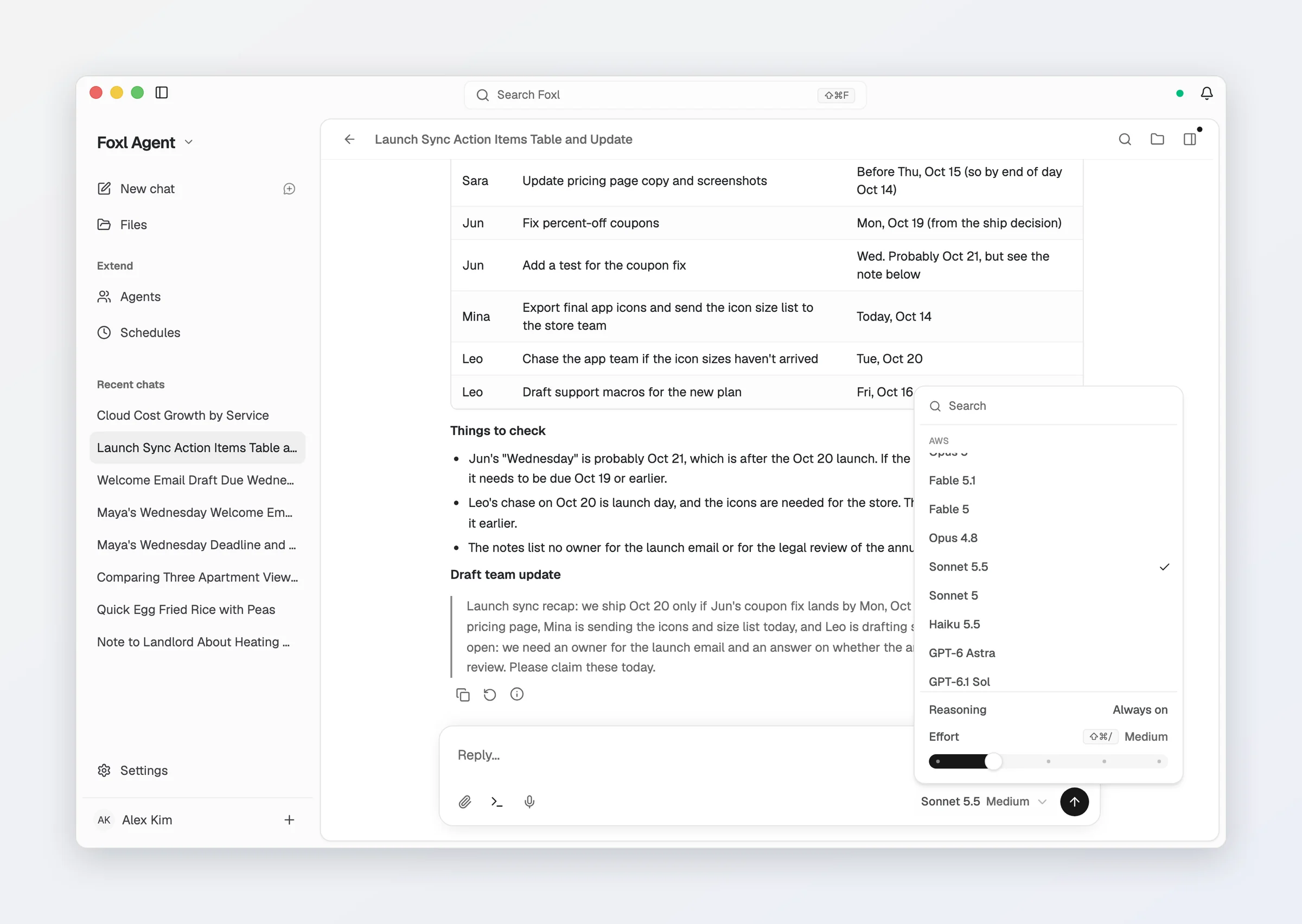
By default every chat uses the model you picked most recently. Turn on Remember the model for each chat in Settings > Chat and opening a chat switches the picker to the model you last used in that chat; as when you pick one yourself, that model also becomes the one new chats, schedules and channels use. It is off by default.
Web App
On app.foxl.ai and the phone apps, chat runs on your Foxl desktop, and the model button shows the model your desktop has selected until you pick one there. A model you pick on the phone or in the browser is kept on that device, and a message you send with it switches your desktop to it too.
On the accounts remote chat is offered to, with it on and your computer away, the picker lists the models a cloud reply can run instead, by name, and the cloud reply uses the one you pick, with its reasoning setting and its full context window (1M tokens on Opus 5.5 and Sonnet 5.5). The cloud keeps its own pick, so the model your computer uses is unchanged when it is back.
Either way, the list you see is whatever the providers you connected serve. With no provider connected the picker says so - No provider connected yet - and offers Open Model & provider, and the model button reads Connect a model. On the web and phone apps the list comes from your Foxl desktop, so it is empty while the desktop is unreachable.
Context window and compaction
Foxl sizes a conversation by the context window of the provider you are connected through (the same model can have a smaller window on a subscription than on Amazon Bedrock), and summarizes a long conversation when its next request would reach about 90% of that window (a little earlier on the few GPT models whose input limit is below their window, such as GPT-6 Astra). The context meter reads the same window.
Connecting a model
- Go to Settings > Model & provider
- Pick a provider - Anthropic, OpenAI, Google AI, Amazon Bedrock, Ollama, Gemma 4 under On this device on a Mac with Apple Silicon, a Windows PC or a Linux x64 computer, one of the OpenAI-compatible vendors (OpenRouter, DeepSeek, Groq and the rest, plus a local vLLM or LM Studio server), or an OAuth subscription. On a desktop where nothing can answer a chat yet, first-run setup also offers Connect with OpenRouter
- Enter your API key, or run that vendor's login once for OAuth
- Select a model from that provider
API keys and local models are configured on the desktop app. At app.foxl.ai and on the phone, chat runs on your desktop through the desktop relay, so the model list there is whatever your desktop has connected - the browser and the phone hold no key of their own. OAuth subscriptions are the same, and additionally read a credential file the vendor's own CLI wrote on your machine.
Subscription OAuth
Use a subscription you already pay for - no API key needed.
| Subscription | Set up once with |
|---|---|
| Claude Pro/Max | claude /login (or claude setup-token) |
| ChatGPT Plus/Pro | Sign in with ChatGPT in Settings > Model & provider > OpenAI (OAuth), or npx @openai/codex login in a terminal; either writes ~/.codex/auth.json |
| Gemini CLI | gemini auth login |
Then pick the matching provider in Settings > Model & provider; Foxl auto-detects the credential. On a new install whose default model cannot run on the computer (no AWS credentials, for example), Foxl picks a sign-in it finds by itself, in this order: Claude Code, then ChatGPT, then Ollama, and says so above the message box until you pick a model yourself. See AI Providers for details on all supported providers.